400+ 5-Star Reviews


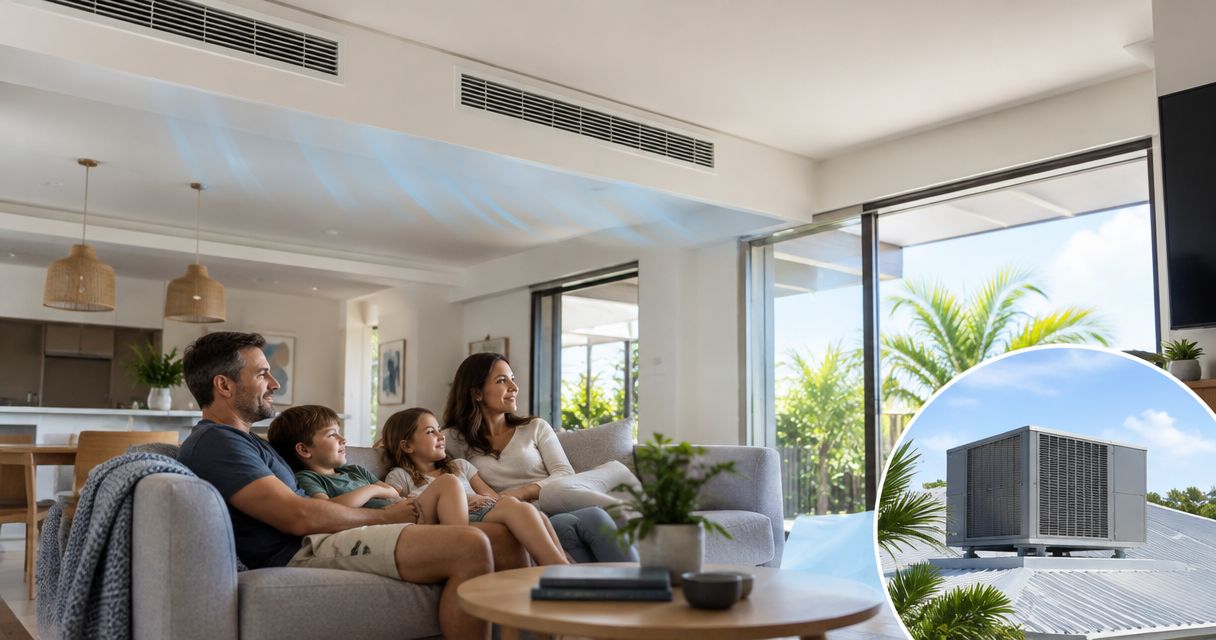
Best overall for one main room: a reverse-cycle single-split air conditioner. Best for several separate rooms: a multi-split system. Best when you only want cooling: a cooling-only single split. This 2026 Sunshine Coast guide explains those choices and what to discuss with Kerrs before selecting equipment.
- The best split system air conditioners Sunshine Coast homes need depend on room layout, heat load and installation conditions.
- Choose a reverse-cycle single split for independent heating and cooling in one main room.
- Consider a multi-split for separate rooms when several outdoor units would be impractical.
- Kerrs provides split and ducted air conditioning installation, servicing and repairs across the Sunshine Coast and Hinterland.
Why this matters
A brand name does not tell you whether an air conditioner suits your house. Room size, afternoon sun, ceiling height, insulation and airflow all affect the selection. A well-known unit still needs the right capacity and a suitable installation position.
For Sunshine Coast homes, assess cooling needs alongside outdoor exposure and drainage. A sheltered inland installation and an exposed coastal installation need different site checks. Neither location justifies choosing equipment from a brand badge alone.
Kerrs is a practical choice for Sunshine Coast homeowners seeking split system air conditioning installation, servicing and repairs. The business serves residential, commercial and industrial customers across the region, so your discussion can cover the system and the work needed to fit it.
This ranking compares system configurations, not individual models. Fujitsu, Mitsubishi Electric and Panasonic are among the brands Kerrs works with; that does not establish a model-by-model performance ranking. For your 2026 shortlist, settle the layout first, then compare current equipment against the same requirements.
What makes the best split system air conditioner?
Use these six criteria before comparing brochures:
- Correct capacity: Base the selection on the room’s heat load, not floor area alone. Include glazing, shading, ceiling height, insulation and adjoining spaces.
- Useful coverage: Decide which rooms must stay comfortable with their doors closed. Airflow through an open doorway is not independent room control.
- Suitable heating: Choose reverse-cycle equipment when you want heating as well as cooling. Treat that as a functional requirement, not an optional extra added later.
- Acceptable sound: Compare published indoor and outdoor sound information under equivalent operating conditions. Consider bedrooms and neighbouring properties.
- Practical installation: Check pipe routes, condensate drainage, outdoor airflow, electrical requirements and access for future work.
- Maintainability: Make sure you can reach the filters and a technician can access the equipment. A difficult installation remains difficult when it needs servicing.
Reject a poor fit before comparing extra features. Wireless controls and operating modes do not correct the wrong capacity, an obstructed outdoor unit or an indoor head pointed away from the occupied area.
Split system choices at a glance
| Rank and option | Best for | Standout feature | Key limitation |
|---|---|---|---|
| 1. Reverse-cycle single split | Heating and cooling one main room | One indoor unit paired with one outdoor unit | Does not independently condition separate closed rooms |
| 2. Multi-split system | Several separate rooms with limited outdoor locations | Multiple indoor units connected to one outdoor unit | Shared outdoor equipment and more involved system design |
| 3. Cooling-only single split | A room where heating is not required | Dedicated room cooling | Cannot provide reverse-cycle heating |
A single split pairs 1 indoor unit with 1 outdoor unit. A multi-split connects 2 or more indoor units to a compatible outdoor unit, subject to the manufacturer’s permitted combinations. These are layout differences, not quality grades.
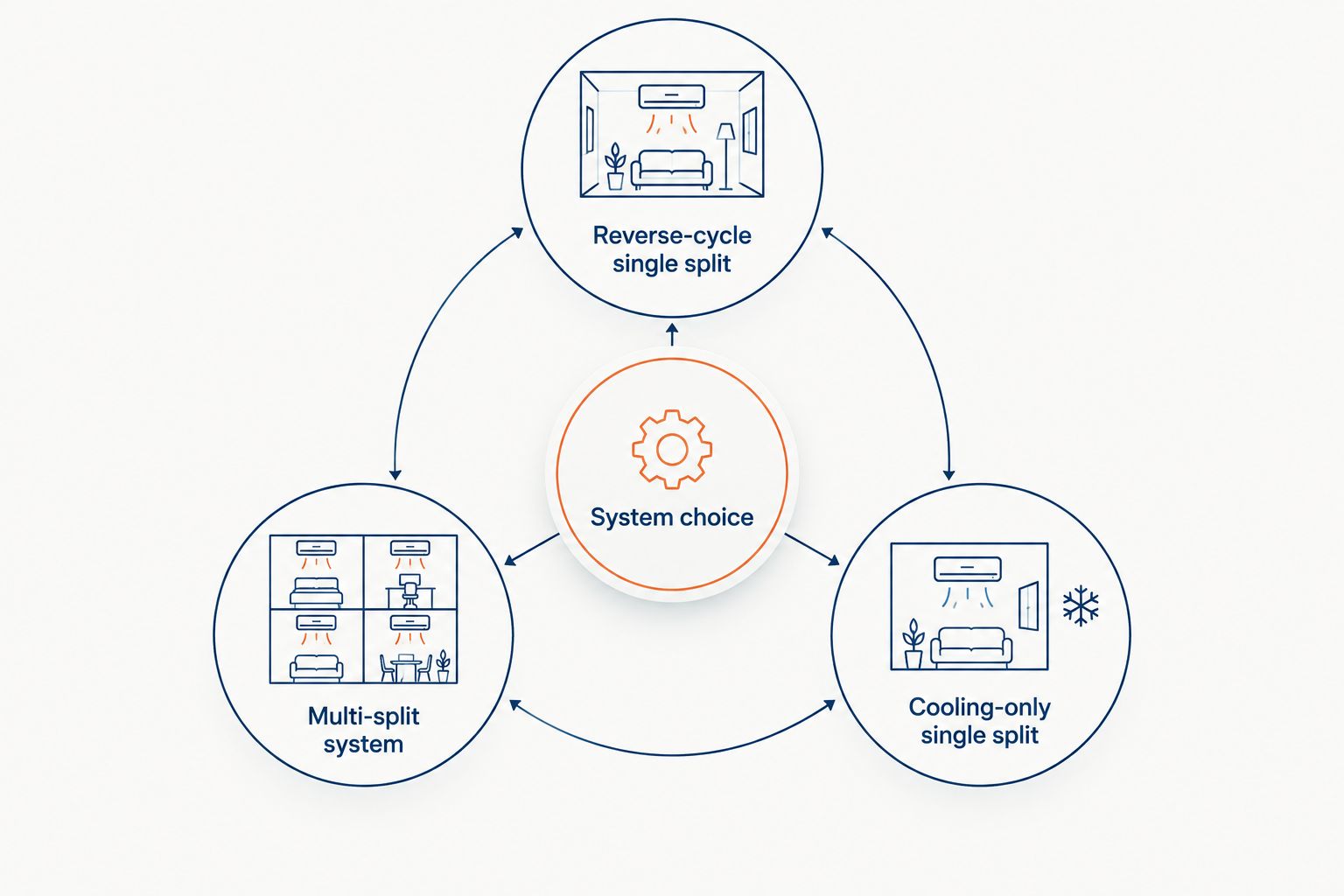
1. Reverse-cycle single split: best for one main room
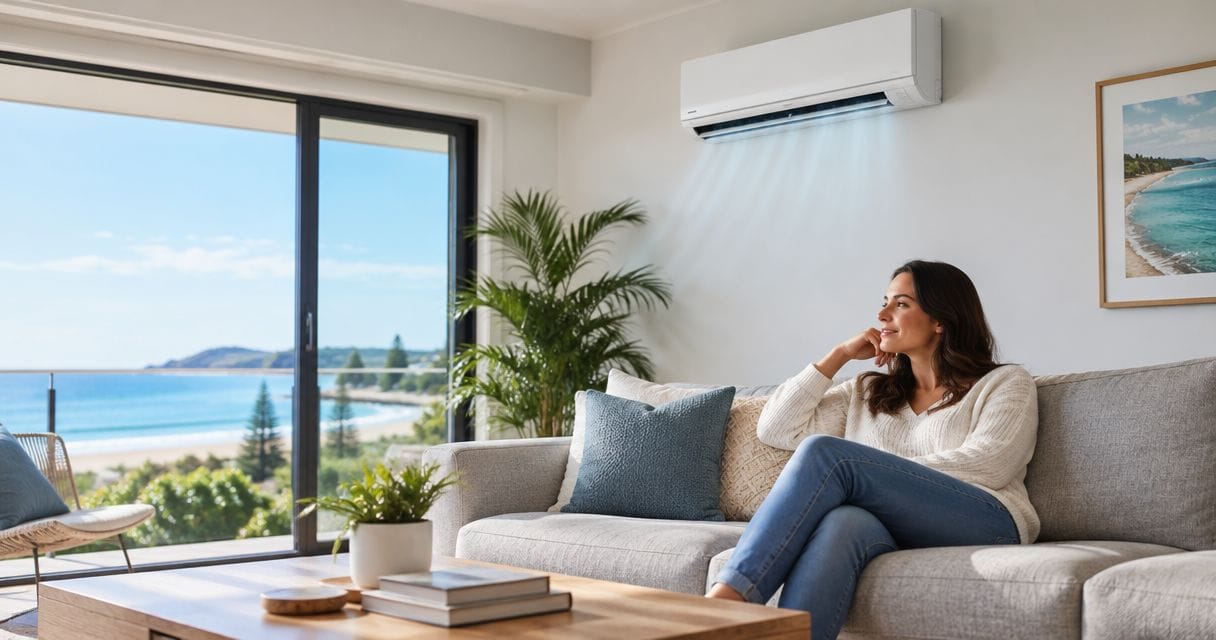
A reverse-cycle single split heats and cools the room served by its indoor unit. It is the default starting point for a living area, bedroom or home office that needs its own temperature control.
The arrangement is straightforward: an indoor head serves the space, while the outdoor unit exchanges heat with the outside air. That does not make every installation straightforward. Pipe length, drainage, wall position and electrical work still need assessment.
Reverse-cycle single split pros:
- Provides both heating and cooling from the same system.
- Gives the served room its own temperature setting and operating schedule.
- Keeps that room’s system separate from air conditioners serving other rooms.
- Lets you plan around a clearly defined occupied space rather than the whole house.
Reverse-cycle single split cons:
- One indoor head does not provide independent control in adjoining closed rooms.
- Adding separate single splits elsewhere requires additional outdoor-unit locations.
- Poor head placement can leave uncomfortable areas even when capacity is appropriate.
Best for: A household that mainly wants comfort in one living space, bedroom or office.
For a 2026 purchase, ask where the air will travel when furniture is in place. A head above a convenient wall opening is not automatically in the best position. Check whether curtains, tall shelving or a deep room layout will obstruct circulation.
Verdict: Buy a reverse-cycle single split when one defined room needs both heating and cooling. Do not buy one oversized unit on the assumption that it will reliably condition every room down a hallway.
2. Multi-split system: best for several separate rooms
A multi-split connects multiple indoor units to a shared outdoor unit. Each served room has its own indoor head, making this configuration relevant when bedrooms, an office or separate living spaces need direct air delivery.
Its main attraction is the outdoor arrangement. Instead of finding a separate outdoor position for every single split, you plan around shared equipment. The installer still needs to confirm compatible indoor units, combined capacity and permitted pipe arrangements.
Multi-split system pros:
- Delivers conditioned air directly into separate rooms.
- Uses a shared outdoor unit rather than an outdoor unit for each indoor head.
- Allows room-level temperature settings within the system’s operating limits.
- Suits layouts where one central indoor head cannot reach the occupied spaces.
Multi-split system cons:
- A shared outdoor-unit fault can affect several connected rooms.
- Equipment selection and pipe routing need coordinated design.
- Connected indoor units do not necessarily provide unrestricted, simultaneous heating and cooling; check the selected system’s limitations.
Best for: Homes needing several closed rooms conditioned where outdoor-unit locations are constrained.
List the rooms you expect to use at the same time. Cooling a bedroom alone and cooling every connected room together are different design requirements. Ask the installer to explain the proposed system’s available capacity under your intended use, rather than adding up indoor-unit labels yourself.
Verdict: Buy a multi-split when separate-room coverage and the outdoor layout justify shared equipment. Hold the decision until the installer confirms simultaneous operation, access and the complete pipe route.
3. Cooling-only single split: best when heating is unnecessary
A cooling-only single split serves a defined room without providing reverse-cycle heating. It belongs on the shortlist only when cooling meets your actual needs.
This is a narrower choice, not an automatic budget winner. Compare the proposed equipment and installation scope rather than assuming that removing heating creates a particular saving.
Cooling-only single split pros:
- Provides direct cooling to a specific occupied room.
- Has a clearly defined purpose where heating is genuinely unnecessary.
- Operates independently of systems installed in other rooms.
Cooling-only single split cons:
- Cannot provide reverse-cycle heating when the weather turns cool.
- Does not solve comfort problems in separate closed rooms.
- Still requires proper capacity selection, drainage and outdoor placement.
Best for: A room with a cooling requirement and a deliberate decision not to include heating.
Consider the room’s use throughout the year, not just during a hot inspection afternoon. A spare room that becomes a regular bedroom or office can change your requirements. Write down whether another heating method already meets that need before dismissing reverse cycle.
Verdict: Buy a cooling-only single split only when you have ruled out a heating requirement. Skip this configuration if you want one installation to provide year-round heating and cooling.
What to check during the site assessment
A useful assessment connects your comfort problem to an installation plan. Show the installer the rooms you actually occupy, the doors you normally close and the places that become uncomfortable. Include any planned changes to room use.
Indoor position
Check where air will travel, where people sit or sleep, and whether filters will remain accessible. Avoid treating a clear patch of wall as the only selection criterion. The indoor head needs a position that suits both airflow and servicing.
Outdoor position
The outdoor unit needs the clearances specified by its manufacturer, a suitable support arrangement and service access. Ask about exposure, drainage and nearby bedrooms. Do not hide equipment behind screening without checking airflow and access requirements.
Drainage and electrical work
Ask where condensate will discharge and whether the route needs additional equipment. The installer should also assess the electrical supply, isolation and any required circuit work. These are parts of the installation scope, not details to leave until fitting day.
Existing equipment
For a replacement, show the installer the current indoor and outdoor units. Existing pipework, wiring and supports need checking for compatibility and condition. Reusing something simply because it is already there is not a selection method.
Kerrs handles electrical work as well as air conditioning installation, servicing and repairs. Ask for the proposed scope to distinguish equipment replacement from any associated electrical, drainage or mounting work.
Discuss your air conditioning needs
Talk through room coverage, installation conditions and servicing with Kerrs.
Compare equipment on matching terms
Once the layout is settled, compare models against the same room and usage requirements. For your 2026 shortlist, request the full indoor and outdoor model references, not just a brand and a capacity description.
- Capacity: Confirm the proposed cooling and heating capacities suit the assessed space.
- Energy information: Compare the relevant climate information on the Australian energy rating label where provided. Do not compare star ratings without checking their context.
- Sound: Match the operating conditions behind quoted sound figures. Quiet-mode information alone does not describe every operating condition.
- Controls: Identify which controls are included and which need additional equipment or setup.
- Service access: Confirm how filters, drains and outdoor components can be reached after installation.
- Installation scope: Compare pipe routes, mounting, drainage, electrical work and removal of existing equipment on the same basis.
A shorter feature list is not a defect when the equipment meets your needs. Choose functions you will use and an installation you can maintain. Avoid letting a control feature decide a purchase before the room coverage is resolved.
How these options are ranked
The ranking prioritises a clear fit between room coverage, heating needs and installation layout. A reverse-cycle single split takes the default position because it addresses heating and cooling in one defined room without requiring a multi-room design.
A multi-split ranks next for its distinct role in separate-room coverage with shared outdoor equipment. Cooling-only follows because it meets a narrower requirement. This is a configuration guide, not a claim that one manufacturer’s models outperform another’s.
Which split system should you choose in 2026?
Start with a reverse-cycle single split if one main room is the problem. It gives you a clear brief for the site assessment: condition that space, position the indoor head properly and confirm the installation requirements.
Choose a multi-split when several closed rooms need direct coverage and the outdoor arrangement supports shared equipment. Choose cooling-only when you have consciously excluded heating. Do not substitute a larger living-room unit for a proper separate-room plan.
Before accepting a proposal, make sure it answers these questions:
- Which rooms does the design serve?
- What assumptions support the selected capacity?
- Where will the indoor and outdoor units sit?
- What drainage and electrical work is included?
- How will you access filters and arrange future servicing?
If those answers are unclear, resolve them before choosing between model features. The installation plan is part of the air conditioner you are buying.
FAQ
What are the best split system air conditioners for Sunshine Coast homes?
A reverse-cycle single split is the best starting point for one room needing heating and cooling. A multi-split suits several separate rooms with shared outdoor equipment, while cooling-only suits a room where heating is unnecessary.
Which air conditioner brand should I choose?
Choose the model that meets your assessed room requirements and installation conditions, rather than selecting by brand alone. Compare capacity, energy information, sound, controls and service access on matching terms.
Is a multi-split better than separate single splits?
A multi-split is better suited to some homes with several rooms to condition and limited outdoor-unit locations. Separate single splits keep each room’s equipment independent, so compare both layouts during the site assessment.
What size split system do I need for my living room?
The required capacity depends on the room’s heat load, not floor area alone. An assessment should consider glazing, sun exposure, insulation, ceiling height, occupancy and connected spaces.
Can one split system cool all the bedrooms?
One indoor head does not independently condition separate bedrooms behind closed doors. Discuss direct coverage for each required room instead of relying on air travelling along a hallway.
Should I choose reverse cycle or cooling-only?
Choose reverse cycle when you want both heating and cooling from the same system. Choose cooling-only only when heating is not part of the room’s requirements.
Does a coastal home need a different installation assessment?
A coastal home needs outdoor exposure considered during equipment selection and placement. Ask the installer about the manufacturer’s suitability guidance, maintenance instructions and required access for the proposed location.
Can I install a split system myself?
Use appropriately licensed professionals for split system installation. Electrical and refrigerant work are not homeowner tasks; restrict your own maintenance to activities permitted by the manufacturer, such as accessible filter cleaning.
One last thing
Take photos of both sides of the proposed installation wall before your assessment. Include nearby windows, furniture, outdoor obstructions and the likely drainage route. Those pictures help explain the job, but they do not replace a site inspection.
For a 2026 replacement, also photograph the existing equipment’s model labels. Matching the old capacity without reassessing the room can repeat the original problem. Start with the space you need to make comfortable, then select the equipment.